Our History
The History of the Mother Organization
Les petits frères des Pauvres (Little Brothers of the Poor) was founded in France in 1946 by Armand Marquiset – a French nobleman who died in 1981. Armand Marquiset decided to devote his life and his fortune to the service of the poorest of the poor in the aftermath of the destruction of World War II.
His mentor, the Abbé Audouin, told him, "The great victims of the war are the old. They have, for the most part, used up their savings. They are barely hanging on to their homes; many are disabled. They are the poor of today, and you should concern yourself with them."
Armand began alone in an impoverished neighborhood in Paris, carrying the meals he cooked himself up six flights of stairs to the attic rooms where so many lonely and forgotten elderly persons lived, no longer able, physically or financially, to look after themselves.
Soon he was surrounded by a group of young volunteers, and aided by the money he unashamedly cajoled from his wealthy friends. Les petits frères des Pauvres grew quickly into the international organization it is today.
At the same time as the affiliates in France (Paris, Lille, Nantes, Lyon, Marseille and Toulouse) were established, other affiliates were founded in the course of the years in Casablanca, Morocco, and Chicago, USA.
Currently, les petits frères des Pauvres operates in the nine following countries: France, USA, Canada, Mexico, Spain, Germany, Ireland, Switzerland and Poland.
These different and nationally independent organizations are united in the Fédération Internationale des petits frères des Pauvres, which has consulting status (category II) with the United Nations Economic and Social Council.
The History of our National Organization
In 1991, 45 years after the foundation of les petits frères des Pauvres by Armand Marquiset in France the organization finally opened its doors in Berlin, Germany, too. Germany, with its office in Berlin, was admitted in June 1991, as member of the International Federation of petits frères des Pauvres. The organizations relationship with the founding organization in France and the International Federation is very close.
Why the decision for Berlin?
Being that the French - German relationship is a dominant factor, in the political-economic sense, for the development of Europe, it was only natural for petits frères to look to its neighbor to expand.
 |
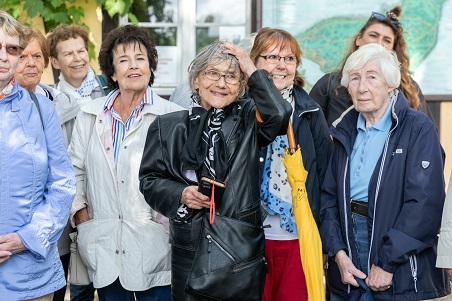
This photo shows the founder board president, Mr. Stephan Tietz (middle), Ex-Senator of Social Welfare, Stahmer (second left) and Marie Villez, president of the Petits Frères - France (second right) at the official opening celebration of the organization in 1992 |
Germany is indeed a rich and prosperous country, but it produces never-the-less or perhaps despite its economic strength a large number of disadvantaged persons, to which includes a growing number of elderly persons. The growing number of unemployed over the age of 50 and the rise in the number of traditionally disadvantaged retired aged single women in conjunction with the negative age pyramid in the German society, the corresponding problems can clearly be seen. Added to these trends is an increasing isolation factor occurring in today's global society due in part to the technical advances allowing everything to be done on computer in the convenience of one's own home without any personal contact and in part to the breakdown of the traditional extended family structure, which has made a large impact on socially disadvantaged elderly people.
All these factors were reason enough for the organization to bring its vision to Germany. The organizational values include being primarily volunteer run, financed from the private sector and the offering (in the traditional sense) of no services.
There are many reasons apart from its symbolic value to Germany for the decision to start in Berlin: With regards to the general problems of a large city, Berlin has a lot in common with other European metropolis'. It has always given particularly strong feedback over social problems and conflicts which then in turn have been heatedly debated and acted upon. Berlin has often been a gauge for estimating the seriousness of situations which will be faced in the near future in the rest of Germany. And in the problem area of old age, which is particularly interesting to us, Berlin leads in the statistics in Germany.